The Rise of Coffee
This Article From Issue
March-April 2008
Volume 96, Number 2
It is said that a mathematician is a device for turning coffee into theorems. Countless other people, of course, also feel that coffee is necessary to get their brains functioning in the morning. Such greats as Napoleon apparently shared that sentiment, as he once said, "A very strong coffee resurrects me. It causes an internal stewing, a singular gnawing, a pain which is not without pleasure."
Figure 1A. Coffee gives many people some much-needed stimulation to get going every morning, and over the centuries the plant has also provided artistic inspiration. This 18th-century French illustration personifies coffee (right) and tea; in the accompanying story they are discussing which one is better than the other.
From Jean-Julien Grandville, Les fleurs animées, Paris, 1867. Courtesy of Fernando E. Vega.
I developed an interest in coffee during my years as an agriculture student at the University of Puerto Rico—my native land still takes pride in once being the sole provider of coffee for the Vatican. My research on insects associated with coffee plants, conducted over the past 11 years, has deepened my appreciation. I have come to see that the seeds that produce this "black wine" have a very interesting biological and social history. Over the centuries, coffee has grown from an enigmatic botanical curiosity, often incorrectly described and misclassified, to the staple product so popular today.
From its humble origins in Africa, coffee has become the second most heavily traded commodity in the world, after petroleum products, with an estimated retail value that exceeds $70 billion. Coffee is planted in more than 10 million hectares spread over 50-plus countries, where more than 100 million people depend on it for their livelihoods.
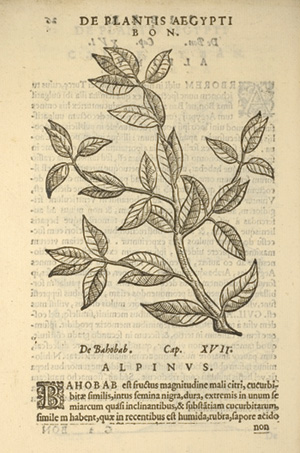
Carl Linnaeus, the Swedish botanist who popularized the standard method of giving organisms genus and species names, first proposed the genus Coffea in 1737. Coffea belongs to the family of flowering plants called Rubiaceae, which contains around 600 genera and 13,500 species. Even though more than 100 species have been described in the genus Coffea, only two, Coffea arabica and Coffea canephora (also known as robusta), are commercially traded. Within these two species, there are numerous "cultivars," often named after the place from where they originated, that are said to provide different flavors and qualities. Cultivars, by definition, are not separate species.
Coffea arabica is endemic to the highlands of Ethiopia, southeastern Sudan and northern Kenya. At some point in history, C. arabica made its way from its place of origin to Yemen. Various accounts have been proposed to explain how and why this dispersal happened, but none is conclusive. What is certain is that the first record of the coffee beverage occurred in Yemen, where by 1450 it was in use by practitioners of Sufism. Over the next century, coffee's popularity spread from Yemen to Cairo to Damascus and then to Istanbul. This expansion resulted in the birth of the coffeehouse, a meeting place where news, ideas and political debate were (and still are) commonly exchanged.
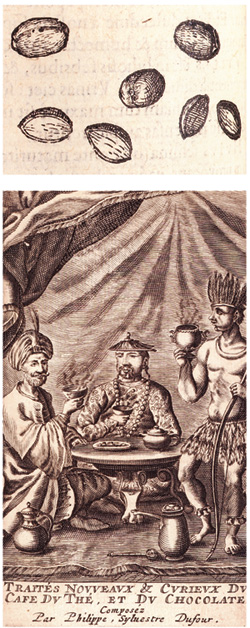
Figure 2. The first illustrations of the coffee berry (top) were published by Charles de L'Écluse, director of the Botanical Garden in Vienna, in 1605. His work, Exoticorum Libri Decem, first uses the term "buna," an Ethiopian word for coffee. In Traitez nouveaux et curieux du café, du thé et du chocolate, an enormously popular book from 1685, Philippe Sylvestre Dufour showed a Middle Eastern man drinking coffee (left), an Asian man drinking tea (center) and a native of the Americas drinking chocolate (right).
Courtesy of the Hunt Institute for Botanical Documentation, Carnegie Mellon University.
Sir Francis Bacon penned one of the first descriptions of a coffeehouse in his posthumously published Sylva Sylvarum from 1627. He wrote: "They have in Turkey, a Drinke called Coffa, made of a Berry of the same name.… And they take it, and sit at it, in their Coffa-Houses, which are like our Taverns." Trade led European merchants to become familiar with coffee as a beverage—the first coffeehouses in Europe opened in Venice in 1645 and in Oxford in 1650. By 1663 more than 80 coffeehouses were in operation in England, a number that increased to more than 3,000 by 1715. The first coffeehouse in the United States, London Coffee House, opened in Boston in 1689, and the first one in New York, The King's Arms, opened in 1696.
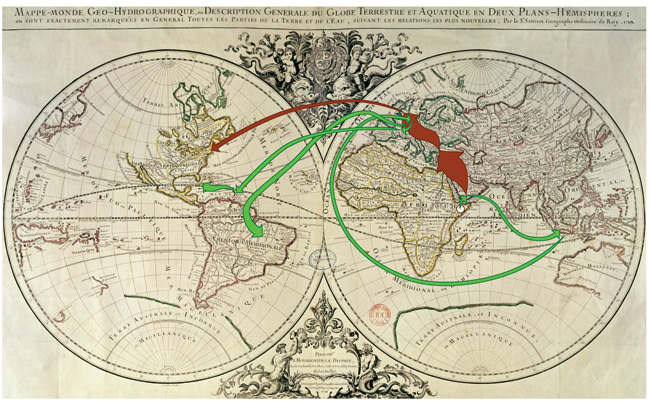
Figure 3. Coffee is now grown in large regions of Africa, South and Central America, the Caribbean and Southeast Asia, and people all over the world drink it regularly. The plant is endemic to Africa but reached many other locations between the mid-1400s and the early 1700s. Green arrows show the plant's travels during this period to countries where it was cultivated; red arrows show the spread of the coffee beverage. Coffee was first transported from Ethiopia to Yemen and from there spread over land to Cairo, Damascus and Istanbul. From Turkey, the drink became popular in Venice, in England and through much of Europe. Dutch traders transported plants from Yemen to Java, back to Amsterdam, and later to their South American colony of Suriname, where cultivation expanded to French Guiana and Brazil. From Amsterdam, plants also made their way to France and then to Martinique, from where they were disseminated throughout the Caribbean.
Geo-Hydrographic Mappamonde/Bibliotheque Nationale/The Bridgeman Art Library
During coffee's introduction to the palates of European consumers, botanists also discovered it as an object of study. In 1592 the Venetian Prospero Alpino published the first depiction of the plant. It did not show berries, which were not described in Western books until 1605, when Charles de L' Écluse, the director of the botanical garden in Vienna, published Exoticorum Libri Decem.
Early botanical drawings from these books and others were often flagrantly copied by other authors, occasionally with some form of rotation to disguise the similarities. This plagiarism occurred in several subsequent works that described coffee plants. Indeed, some illustrations seem to be drawn only from hearsay, as the features they showed were so different in size or appearance from the actual plant. But as coffee became more popular and common, its depictions also grew more accurate.
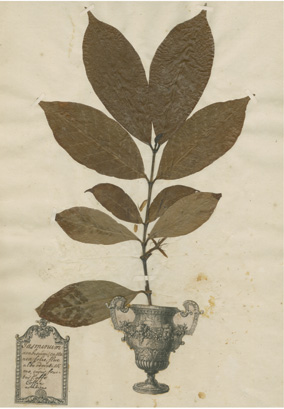
Figure 4. Swedish botanist Carl Linnaeus used this preserved coffee specimen when describing the species in his Hortus Cliffortianus in 1738. Linnaeus spent two years documenting the plants at the estate of George Clifford III, a director of the Dutch East India Company. Linnaeus was also the first to propose the genus name "Coffea."
Linnean Plant Name Typification Project, Natural History Museum, London
The Dutch East India Company started growing coffee in the Dutch colony of Java in the 1690s, using seeds obtained in the port of Mocha in Yemen. In 1706 plants were taken from Java to the Amsterdam Botanical Garden, from which in 1713 a plant made its way to France. French botanist Antoine de Jussieu used this specimen for the first scientific description of coffee's anatomy. In 1720, the French naval officer Gabriel de Clieu left port with two coffee plants, only one of which survived the journey to the French colony of Martinique in the Caribbean. From there, coffee spread throughout the Caribbean islands over just a few decades: to Haiti (1725), Guadeloupe (1726), Jamaica (1730), Cuba (1748) and Puerto Rico (1755). At around the same time, in 1718, the Dutch transported plants from Amsterdam to their South American colony of Suriname, which led to the crops' introduction into French Guiana a year later and then to Brazil in 1727.
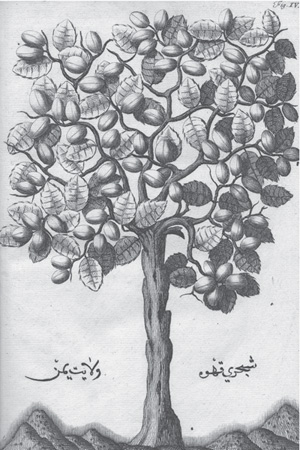
Figure 5A. Although the coffee plant can grow to a tree that is as much as 5 meters tall, some early botanical illustrations enormously exaggerated the size of berries, leaves and flowers. This one is from Bevanda Asiatica by Jacob Spon, published in Leipzig in 1705.
Richard von Hünersdorff Rare Books, London
Because the global dissemination of coffee was based on a limited selection of plants growing only in Java, all of which had originated from a few seeds obtained in Yemen, the increased geographic range did little to boost the plant's genetic diversity. The genetic monotony of the new areas under cultivation was further exacerbated because C. arabica is self-pollinating, or autogamous, one of three species in the entire genus that has this trait. All other species are allogamous and need to be cross-pollinated, which increases their chances for obtaining genetic differences.
Figure 5B. Another early, exaggerated botanical illustration, published in 1721, is from The Virtue and Use of Coffee, by Richard Bradley, the first professor of botany at the University of Cambridge, depicting coffee plants in Amsterdam.
Johann Jacobs Museum, Zurich
One such allogamous species is C. canephora, a diploid plant. Diploids get a set of chromosomes from each parent; C. canephora gets 11 from each of its paternal plants, giving it a total of 22 chromosomes. C. arabica is an allotetraploid, meaning that sometime during its evolution it likely got two full sets of chromosomes from two diploid species that hybridized, giving it 44 chromosomes. Allotetraploids are quite rare in nature, and C. arabica is one of the few examples. Molecular characterization indicates that C. arabica is the result of a crossing between the diploids C. eugenioides and C. canephora. But it is estimated that the genetic variation in C. canephora is 10 times that in C. arabica, despite the latter's larger complement of chromosomes.
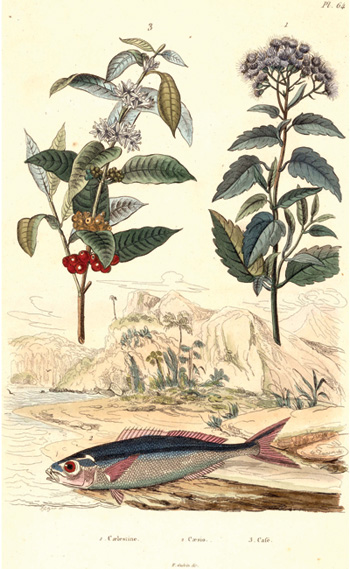
Figure 6. As coffee became more commonly known in Western countries both as a beverage and as a plant, botanical illustrations of the plant's anatomy and life cycle became more intricate and accurate. This drawing in a book compiled by French entomologist Félix-Édouard Guérin-Méneville, from 1835, shows a coffee branch (left) with three stages of coffee-berry development, as well as open and developing flowers. From 1833 to 1839 Guérin-Méneville was in charge of the Dictionnaire pittoresque d'histoire naturelle et des phénomènes de la nature, comprising nine volumes and 720 plates, including this illustration.
Courtesy of Fernando E. Vega
Another major difference in the two species is their optimal elevations for cultivation: C. canephora, which is endemic to the equatorial lowland forests of Africa, thrives below 700 meters, whereas C. arabica grows better higher up (1,000 to 2,000 meters). Approximately 70 percent of the world's coffee output consists of C. arabica. In Latin America, more than 95 percent of the crop is C. arabica, in contrast to Africa, where 80 percent is C. canephora.
Figure 7. This 1751 depiction shows a small branch with berries next to the full coffee plant, a detail of one leaf, and various stages of development of the flowers and berries. This plate is from the 28-volume Encyclopédie, ou dictionnaire raisonné des sciences, des arts et des métiers, par une société de gens de lettres, edited by Denis Diderot and Jean Le Rond D'Alembert. That work remained one of the most famous and comprehensive scientific reference books long after it was published.
Courtesy of Fernando E. Vega
Considered as a commodity, coffee is measured in 60-kilogram bags, and the largest producers in 2006 were Brazil (about 42 million bags), Vietnam (about 15 million) and Colombia (about 12 million). Brazil and Colombia are the top growers of C. arabica, whereas Brazil and Vietnam cultivate the most C. canephora. Coffea arabica commands a higher price than C. canephora in the world's markets due to its perceived higher quality, even though this is more a matter of consumer preference. Many coffee drinkers prefer arabica coffee, but others will tell you that robusta (or canephora) provides a perfectly good cup. Nonetheless, recent prices average $1.30 per pound for green (unroasted) C. arabica coffee and $0.90 for C. canephora. One major difference between these two species is the content of the alkaloid 1,3,7-trimethylxanthine, which is better known as caffeine. C. arabica has on average 0.8 to 1.4 percent caffeine, in contrast to 1.7 to 4.0 percent in C. canephora. Thus, the latter species is often used in blends to increase caffeine content.
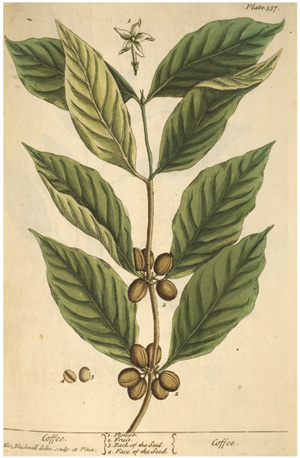
Figure 8. In 1739, the first botanical illustration of coffee by a woman was published. Elizabeth Blackwell produced two volumes of 500 plates. She modeled her pictures on live specimens at the Chelsea Physic Garden in England. Her book was titled A Curious Herbal, Containing Five Hundred Cuts, of the Most Useful Plants, which are now Used in the Practice of Physick: Engraved on Folio Copper Plates, after Drawings Taken from the Life.
Courtesy of the National Library of Medicine
The search for high-quality coffee nowadays is, fortunately, a far cry from Edward Abbey's 1982 description in Down the River. He wrote, "Our culture runs on coffee and gasoline, the first often tasting like the second." But defining quality is an issue of astounding complexity—more than 800 volatile compounds can be detected in the aroma of roasted coffee. In addition, the parameters that professional testers (called "cuppers" in the coffee industry) use for defining quality have in the past been quite variable throughout the world. But in recent years more uniform standards have begun to be applied. For example, judges for the "Cup of Excellence" competition (essentially the Oscars for coffee) base their evaluations on such parameters as aroma, "clean cup," sweetness, acidity, "mouth feel," flavor, aftertaste and balance. For each of these attributes, cuppers are trained to rate several different variables, which depend on the growth environment, cultural practices, type of cultivar and postharvest processing of the berries.
It is commonly held that coffee from various locales has distinctive flavors. For instance, the famous Panamanian-grown Gesha cultivar—named after the region from which it originates in Ethiopia—recently fetched over $130 per pound at auction. This coffee's taste has been said to include tones of honey, flowers and chocolate. Having purchased half a pound of this cultivar, I can confirm that it is indeed remarkable and unique. Another exclusive type is known as civet coffee or kopi luwak. It is made from coffee seeds found in the droppings of the common palm civet (Paradoxurus hermaphroditus), a small mammal found in Indonesia, and sells for $120 to $150 per pound. However, although growing conditions and locations undoubtedly affect the taste of coffee, of paramount importance among the many variables is the processing of the harvested berries.
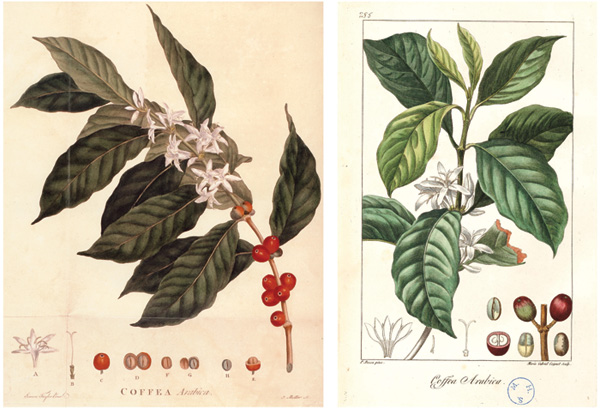
Figure 9. By the late 1700s, illustrations of coffee had reached great heights of both beauty and accuracy. In 1774, British naturalist (and colonial official in West Florida and Dominica) John Ellis published this plate in An Historical Account of Coffee (left). Another stunning rendering of C. arabica (right) appears in an 1820 book edited by Jean-Louis Augustin Loiseleur-Deslongchamps, one of the eight-volume series Herbier genéral de l'amateur, which contains hand-colored plates based on paintings by French artist Panacrace Bessa. As can be seen here, most coffee berries contain twin seeds; a seed produced singularly is called a peaberry, which makes a coffee that can be quite desirable.
Image at left courtesy of the Hunt Institute for Botanical Documentation, Carnegie Mellon University; image at right courtesy of Fernando E. Vega
Two methods are standard: wet (also known as washed) and dry (or natural). The wet method involves the discarding of green berries from the batch followed by mechanical removal of the ripe berries' outer skins and pulp, leaving the seed or "bean," which is fermented in water tanks for 12 to 36 hours to break down any mucilage that remains clinging to it. The cleaned seeds are then dried from about 50 percent water content to approximately 12 percent. Drying can be done using sunlight in outdoor patios or on tarpaulins, a process that usually takes three to six days, or it can be carried out using mechanical dryers. Once the seeds are dry, they are hulled, a process in which a layer called parchment or, in Spanish, pergamino is removed. The wet method is common throughout Latin America except for Brazil.
The dry method involves drying entire berries in different stages of ripening, a process that takes approximately two to three weeks if the berries are sun dried, followed by hulling. This method is quite common in Brazil and in Africa. The wet and dry methods have been used for hundreds of years. A third method was developed more recently. Referred to as "semidry" or "pulped-natural," it is also employed in Brazil. Workers first remove the skin and pulp from ripe berries and then dry the seed with its mucilage attached.
Although coffee production is an ancient industry with an enormous amount of scientific research behind it, chemical and molecular studies aimed at understanding the properties behind the various assessments of coffee quality are still in their infancy. Until recently, traditional taxonomic botany also lagged far behind. Aaron P. Davis of the Royal Botanic Gardens at Kew in England and his colleagues have described 16 new coffee species since 2001 and expect to publish on five more in 2008, which will bring the total number of described species to about 25 percent of the diversity of the genus.
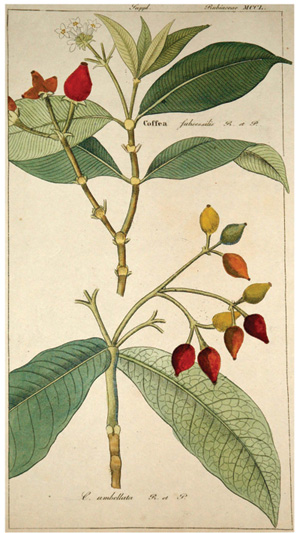
Figure 10. These and four other plant species collected by Spanish botanists Hipólito Ruíz and José Pavón during their 1777-1788 expedition to Peru and Chile, published in their series Flora Peruviana et Chilensis, were inaccurately described as members of the genus Coffea. This error led to the mistaken belief at one point that certain coffee species were endemic to South America. (From David Nathanael Friedrich Dietrich, Flora universalis in kolorirten Abbildungen, 1831.)
Courtesy of Fernando E. Vega
It is generally thought that the most important variables in determining quality are the grade and the homogeneity of the berries (which varies because, for example, the wet method uses only ripe fruits whereas the dry method uses ones harvested in all stages of ripening). Members of Dirk Selmar's group at the Technische Universität Carolo-Wilhelmina in Braunschweig, Germany, have challenged this assumption after examining batches of homogeneous berries subjected to either the wet or dry method. The results indicate that significantly different metabolic processes take place in the coffee seeds depending on how they are processed. For example, higher levels of free amino acids of the type found in proteins were detected in wet-processed coffee in contrast to higher levels of glucose, fructose and gamma amino butyric acid (GABA, an amino acid that is not found in proteins) in dry-processed coffee. These changes influence quality and indicate that the exact same coffee seeds can have different chemical attributes depending on how they are processed.
The long legacy of coffee has finally entered the genomics era, with molecular biologists in Brazil, Italy, India, the United States and Colombia working to elucidate the coffee genome. A recent paper in the Brazilian Journal of Plant Physiology identified more than 30,000 unique genes in DNA libraries from C. arabica, C. canephora and C. racemosa. In addition, members of the International Coffee Genome Network, which formed in 2005, meet on a yearly basis to discuss progress. It will be interesting to see how the recent advances in genomics influence the coffee world. So should you get bored of the Mandheling-Yirgacheffe-Antigua blend you're used to sipping, if neither a Turkish coffee nor a Mocha latte can satisfy your cravings, take solace in the fact that there are lots of fantastic coffees being cupped that will soon be coming your way. It might not be long before we start to tease out the genes that influence the quality of this magnificent beverage.
from Hacker News https://ift.tt/2RqDZLx